
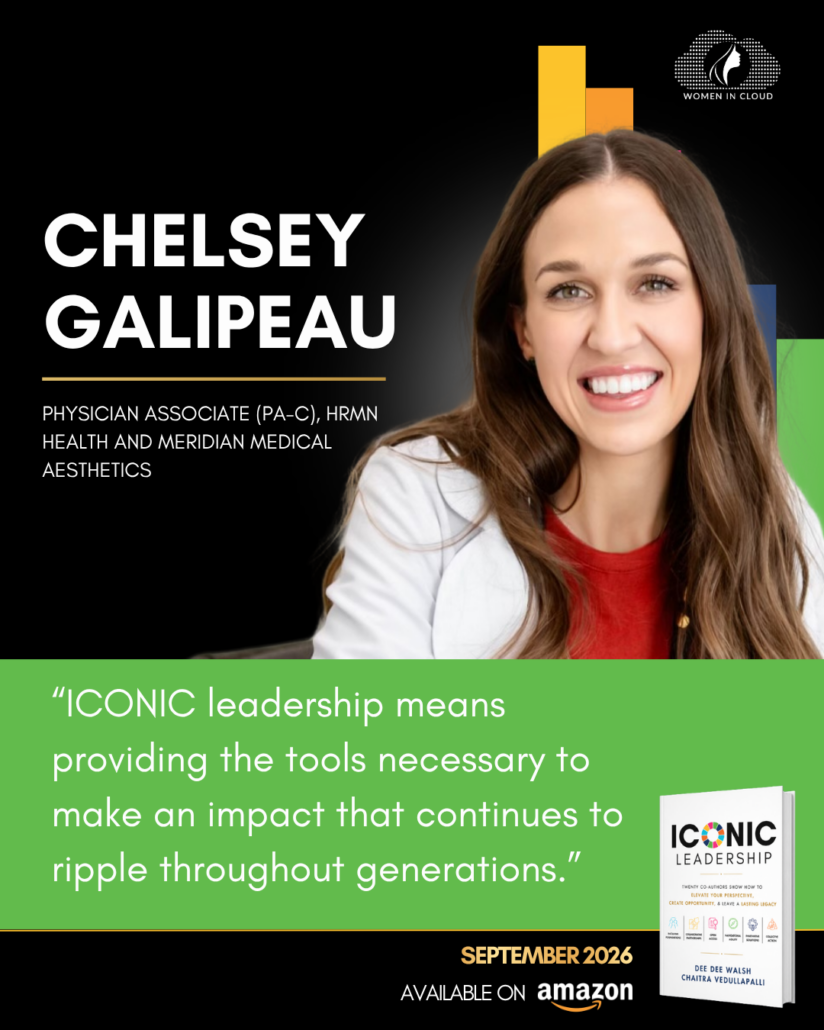
Chelsey Galipeau: When Health Access Becomes Leadership Infrastructure

What happens when a capable, high-performing leader suddenly feels unable to think, communicate, or operate at the level she knows she can?

Too often, the answer is framed as a personal failure. She needs to manage stress better. Become more disciplined. Push through the exhaustion. Adjust to a demanding season.

Chelsey Galipeau offers a different perspective.

Through her work in hormone health, Chelsey has seen how changes in metabolic and hormonal health can affect sleep, cognition, mood, confidence, and executive functioning. These are not isolated wellness concerns. They can shape how a woman participates in meetings, makes decisions, leads a team, pursues advancement, and sustains her long-term ambitions.

Chelsey’s leadership story began with a desire to fill gaps in care. Early exposure to underserved communities showed her that access to healthcare is not distributed equally. Later, while working in endocrinology, she recognized another gap hiding in plain sight. Women were searching for answers, yet the traditional system often gave them too little time, too little education, and too few opportunities to understand what was happening in their own bodies.

For Chelsey, the challenge was not simply clinical. It was structural.

A brief appointment could not always hold the full reality of a woman’s health, responsibilities, stressors, symptoms, and goals. When people are not given time, context, or understandable information, they are limited in their ability to participate in decisions about their own care.

Chelsey chose to build differently.

Her approach centers education, collaboration, and the belief that patients should have a voice in the decisions affecting their lives. Rather than asking people to follow instructions without context, she wants them to understand their options, advocate for themselves, and work in partnership with their providers.

This is where her story connects powerfully to Navigational Agility and Innovative Solutions within ICONIC Leadership. Access is not only about whether a service exists. It is also about whether people can reach it, understand it, trust it, and use it to make informed choices. Innovation begins when leaders question systems that are technically functioning but failing to meet the deeper needs of the people inside them.

Chelsey’s chapter invites readers to reconsider the relationship between health and leadership. It asks what becomes possible when people are given the knowledge and tools to recognize that a change in performance may not reflect a loss of ability, ambition, or potential.

Her deeper framework remains for the book, but its central promise is clear: people deserve more than dismissal. They deserve education, validation, options, and hope.

Because when a person regains ownership of their health, the impact rarely ends with them. It reaches their work, their relationships, their confidence, and the generations watching what they make possible.

Learn More & Get Involved
✍️ ICONIC Leadership Assessment – https://womenincloud.com/iconicleadershipassessment/
▶️ ICONIC Leadership Podcast – https://open.spotify.com/show/6EizaFqN8adxa6WcWPJV0e?si=b442899535694682
📖 ICONIC Leadership Book – https://shop.ingramspark.com/b/084?params=owAAc4hbwh8riSosnpCgvnssQZ0ryWU9ZritStkw3F3
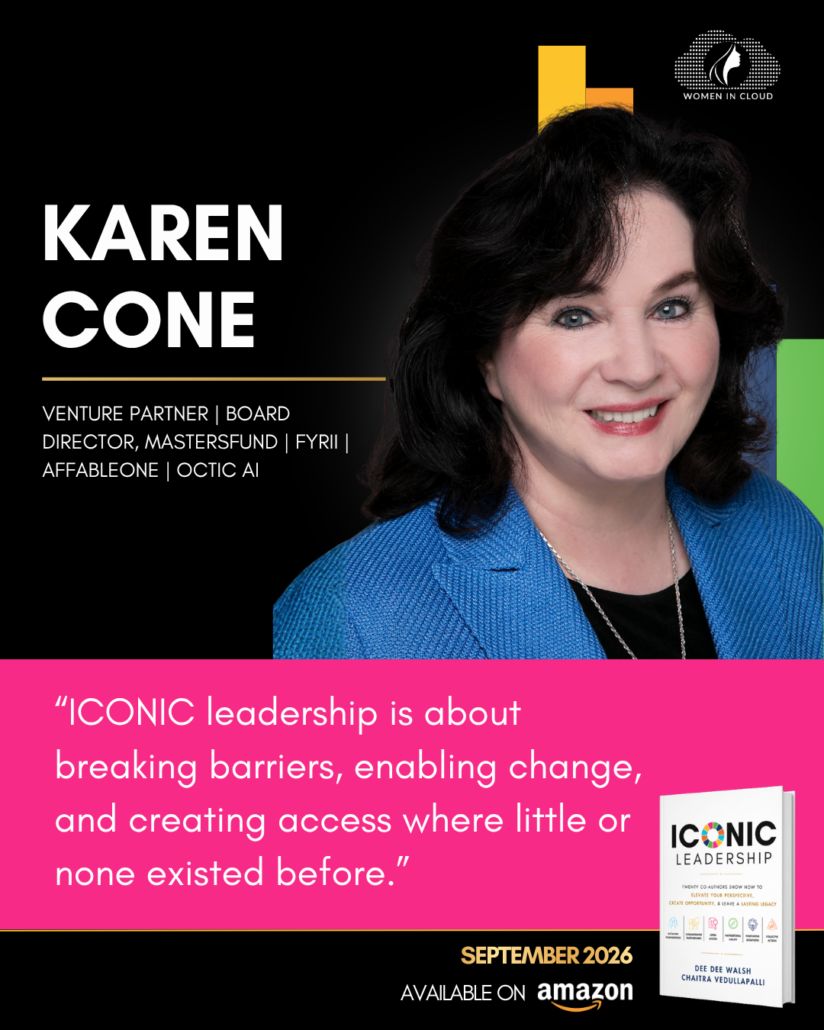
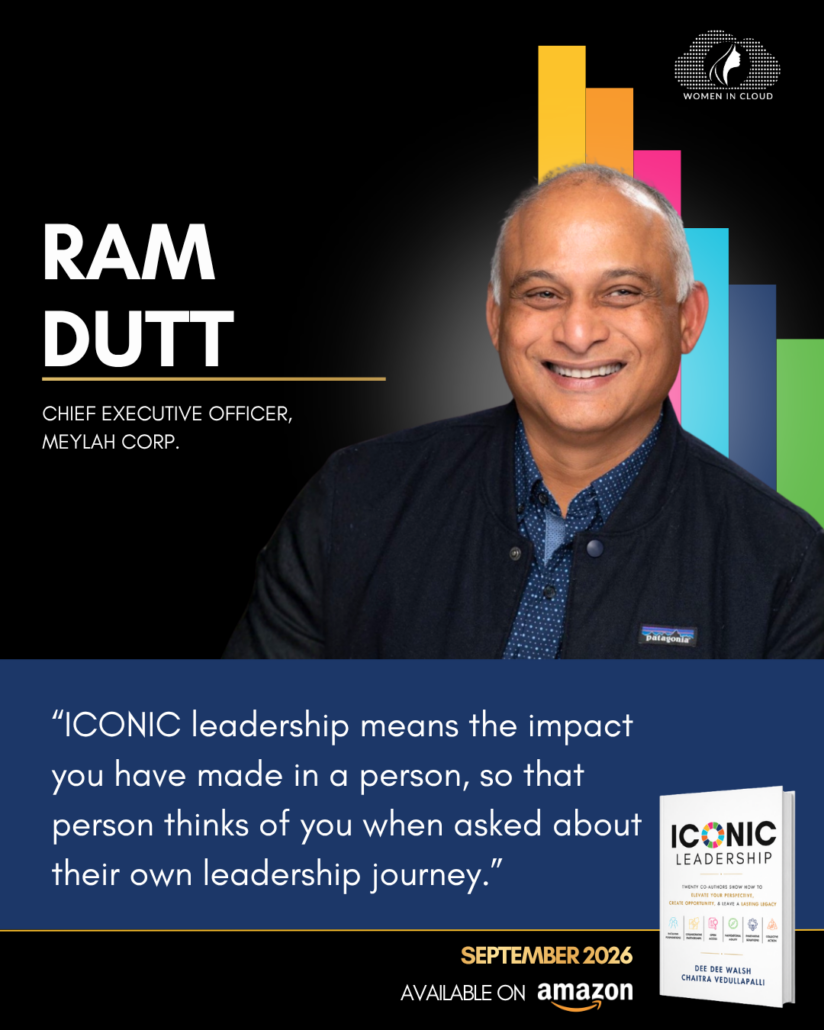
Karen Topping Cone: Creating Access Where Little Existed Before

Breaking a barrier is not always a single dramatic act.

Sometimes it begins with recognizing that a system, opportunity, or path was not designed to include everyone. Sometimes it means entering an unfamiliar space, understanding how influence works within it, and then helping others navigate it more successfully. And sometimes the leader’s most important role is not to make every change personally, but to create the conditions that allow change to become possible.

For Karen Topping Cone, this is where iconic leadership begins.

Her perspective was shaped long before she entered the technology industry, the C-suite, or the boardroom. Growing up across countries, cultures, and political systems exposed her to profound differences in privilege, opportunity, and economic access.

As a child living in Moscow and visiting family in India, Karen saw communities separated not by talent or potential, but by the opportunities and resources available to them. She remembers questioning why some people lived with security and abundance while others struggled for basic necessities. By the age of nine or ten, she was already wondering how people could be given greater economic access and pathways out of poverty.

That early awareness became part of the way she understood leadership.

Throughout her career, Karen repeatedly stepped into industries and roles where she was not the obvious or traditional choice. She entered technology without a conventional technical background, helped organizations navigate periods of transformation, and became known for connecting emerging innovation with the needs of businesses and the people expected to use it.

Her career reflects Navigational Agility, but her philosophy goes further than personal adaptability.

Karen does not define leadership only by a person’s ability to succeed through change. She sees leadership as the ability to enable change for others. That distinction matters.

Leaders do not have to control every outcome or personally execute every transformation. They do need to recognize where progress is being blocked, bring the right people together, and create enough trust, clarity, and access for movement to begin.

Karen learned this lesson in her own advancement as well.

At one point in her career, she was told that although she was producing excellent work, she was being viewed as a worker rather than a leader. Like many women, she had believed that strong results would speak for themselves. She had to learn that visibility, confidence, and the ability to communicate value also influenced who received access to leadership opportunities.

She did not respond by abandoning substance. She learned to make that substance visible.

Karen began entering rooms with greater intention, communicating achievements clearly, and presenting herself as someone prepared to lead. That experience also made her more aware of how easily other people’s contributions could be overlooked.

Once she gained greater influence, she used it to redirect recognition to those whose voices were not being heard. When an idea introduced by a woman was ignored and later repeated by someone else, Karen would bring the conversation back to the original contributor and invite her to expand on it.

That small intervention reflects a much larger leadership choice.

It breaks a barrier to visibility. It enables someone else to participate with authority. It creates access to recognition that might otherwise have been lost.

This is where Karen’s story connects naturally to Open Access and Collaborative Partnerships within ICONIC Leadership.

For Karen, leadership is not about taking ownership of every idea or positioning oneself as the sole source of progress. It is about recognizing the value others bring and using collective strengths to produce something greater. As she explains elsewhere in the interview, leadership must be about “we” and about making “one plus one equal three.”

Her chapter invites readers to reconsider what it really means to create change.

It asks leaders to look beyond their own advancement and examine the barriers surrounding them. Who lacks access to the room? Whose work is being overlooked? Which innovation is ready, but not yet aligned with the people expected to use it? And how can a leader create the conditions for others to move forward?

Because iconic leadership is not only about being the person who crosses the barrier.

It is about weakening that barrier, enabling change, and ensuring that those who follow encounter more access than existed before.

Learn More & Get Involved
✍️ ICONIC Leadership Assessment – https://womenincloud.com/iconicleadershipassessment/
▶️ ICONIC Leadership Podcast – https://open.spotify.com/show/6EizaFqN8adxa6WcWPJV0e?si=b442899535694682
📖 ICONIC Leadership Book – https://shop.ingramspark.com/b/084?params=owAAc4hbwh8riSosnpCgvnssQZ0ryWU9ZritStkw3F3
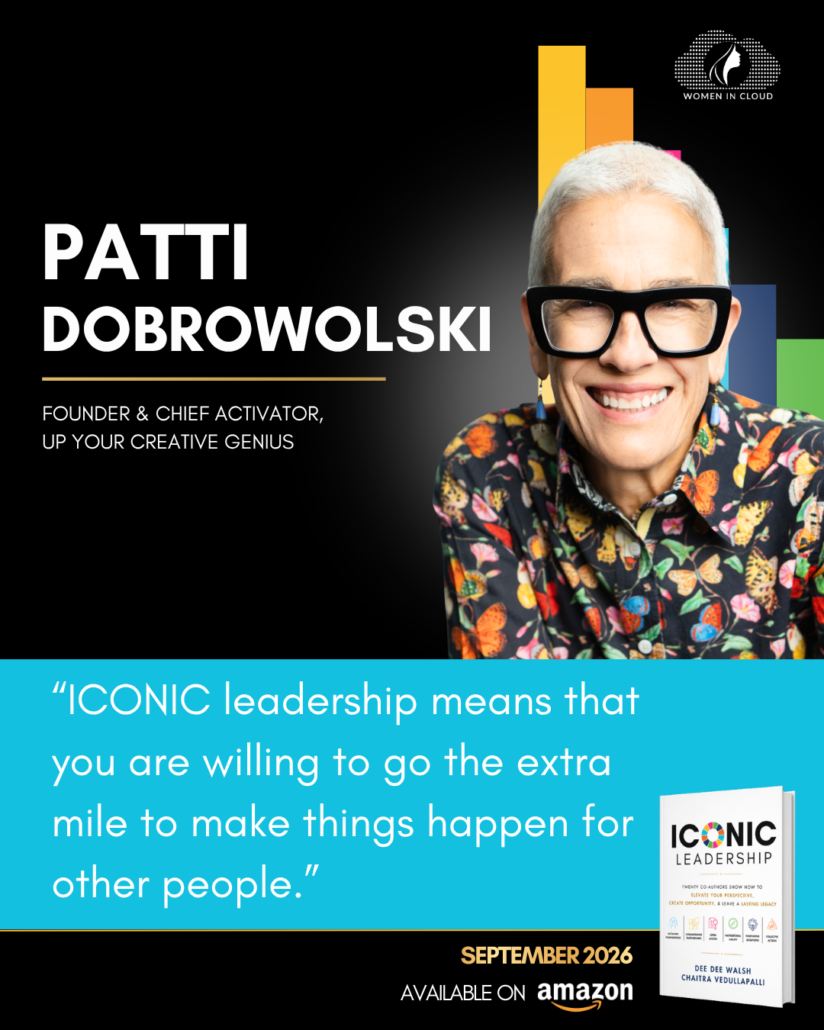
Ram Dutt: Innovation That Improves the Human Condition

Innovation is often measured by what is new.

Ram Dutt measures it by what becomes better.

Across manufacturing, digital transformation, community platforms, education, and artificial intelligence, Ram’s leadership journey has been shaped by a consistent instinct: understand the system, find the friction, and build a more effective way forward.

That instinct appeared early in his career.

As a quality engineer in flexible circuit manufacturing, Ram was asked to move beyond visual inspection and develop new electronic testing methods. The challenge was not simply to install a standard process. Flexible circuits required a different approach, and existing methods did not translate easily.

Ram spent months studying the problem, designing equipment, and creating a testing methodology that could identify functional issues before products reached customers. He also examined the broader manufacturing workflow, looking for defects, communication breakdowns, and gaps between departments.

The lesson was larger than quality control.

A solution becomes meaningful when it is connected to the full system around it.

That systems perspective continued as Ram helped support ISO certification, contributed to a cross-functional business unit, and learned how process, communication, and accountability must work together. One principle stayed with him: say what you do and do what you say.

Over time, his work moved from engineering and technical sales into entrepreneurship and digital platforms. Ram saw that small businesses were being asked to manage disconnected tools for content, commerce, social media, visibility, and customer engagement. Instead of treating each challenge separately, he helped build an integrated platform that brought those functions together.

When the market changed, he adapted again.

Ram recognized that even a strong product could struggle without trusted distribution and community reach. His business evolved from serving individual companies toward building community-based ecosystems where organizations could share visibility, infrastructure, and trust.

This is where Ram’s story connects most directly to the ICONIC Leadership pillar of Innovative Solutions.

His leadership is not innovation for novelty’s sake. It is innovation rooted in practical need. He looks for overlooked connections, questions familiar models, and develops approaches that make systems more useful for the people inside them.

Ram describes one of his greatest organizational contributions as thinking outside the box, identifying opportunities, and creating business models that defy normalcy.

That mindset is especially visible in his approach to artificial intelligence.

Ram sees AI as a powerful tool, but not as an automatic solution. In his school district, he helped explore a focused AI system that could review policies, procedures, and relevant laws, then provide administrators with responses and source references. The goal was not to remove human decision-making. It was to reduce time spent searching through large volumes of material so leaders could focus their attention where judgment mattered most.

That distinction is central to his philosophy.

AI can support research, automate routine work, improve efficiency, and help people connect information more quickly. But Ram believes communication, validation, context, and responsibility must remain under human oversight. Systems need guardrails, especially when automated workflows may affect people, institutions, or public trust.

His approach reflects a form of innovation that is both ambitious and disciplined.

It asks not only, “What can this technology do?” but also, “What problem are we solving, who benefits, and what must remain human?”

That is why Ram’s response to the question of what change he would most like to see in the world is so revealing:

Innovation that improves the human condition.

His chapter invites readers to consider innovation as a leadership responsibility. It requires curiosity, experimentation, and the courage to move beyond accepted models. But it also requires patience, structure, and the judgment to know when a new tool is truly creating value.

Because the most important innovations do more than optimize a process.

They help people work better, decide more wisely, and imagine possibilities that the old system could not support.

Learn More & Get Involved
✍️ ICONIC Leadership Assessment – https://womenincloud.com/iconicleadershipassessment/
▶️ ICONIC Leadership Podcast – https://open.spotify.com/show/6EizaFqN8adxa6WcWPJV0e?si=b442899535694682
📖 ICONIC Leadership Book – https://shop.ingramspark.com/b/084?params=owAAc4hbwh8riSosnpCgvnssQZ0ryWU9ZritStkw3F3
Patti Dobrowolski: Drawing a Future People Can See

Change often fails before the strategy does.

It fails when people cannot see where they are going. It fails when the future feels abstract, disconnected, or designed without them. It fails when a leader announces a destination but never gives people a meaningful place in the picture.

Patti Dobrowolski has spent her career helping people see change differently.

Her work began with performance, storytelling, and a deep belief in the power of imagination. Early in her career, Patti drew pictures in her journal of the future she hoped to experience. One of those visions took her from Seattle to Broadway, with an opening-night party at Tavern on the Green, just as she had once imagined.

But her leadership story was not built through one successful performance. It was shaped through reinvention.

After a devastating review ended one chapter of her artistic career, Patti moved to the Bay Area, became a gardener, returned to school for drama therapy, and eventually entered the world of organizational change.

Each transition taught her something about identity, resilience, and the stories people tell themselves when the future feels uncertain.

Inside organizations navigating mergers, restructuring, and leadership transitions, Patti began to notice a recurring challenge. People were being asked to move forward without a shared understanding of what forward actually looked like.

So she began drawing it.

Patti learned to capture a team’s current reality, the future it wanted to create, and the bold moves that could begin closing the distance between the two. Complex strategies became pictures people could understand, remember, and use to guide decisions.

Leaders could return to those visuals in meetings. Teams could see how their work connected to the larger direction. People who had felt removed from the strategy could finally locate themselves within it.

That belief became the foundation of Patti’s signature Draw Your Future process.

The deeper methodology belongs in her chapter, but the principle is powerful: people are more capable of moving toward a future when they can imagine it, express it, and take ownership of it.

Patti’s process invites people to capture their current reality and desired new reality through pictures and words, then consider the bold steps that could help bridge the distance between them. She believes that drawing helps make the future visible and gives people a stronger connection to what they hope to create.

This is where Patti’s work connects naturally to ICONIC Leadership.

Her leadership reflects Inclusive Foundations because every person’s voice matters in shaping the future. It also reflects Collective Action because a vision becomes meaningful only when people can act on it together.

Patti does not see leadership as drawing the future for others and asking them to comply. She sees it as creating a space where people can contribute, recognize their role, and move with shared intention.

That principle is one of her non-negotiable leadership values. When asked what she would not compromise, even under intense commercial pressure, Patti returned to a clear belief: everyone’s voice matters.

Her commitment to access also shapes her partnership with Women in Cloud.

Patti has trained facilitators around the world so Draw Your Future can extend beyond her own work. Through Women in Cloud, she helped bring the process to hundreds of participants as part of a Guinness World Record initiative designed to help more women envision and step into the futures they wanted to create.

The initiative reflected more than the scale of Patti’s work. It demonstrated what becomes possible when a personal vision is supported by a community prepared to act.

Her approach is grounded not only in imagination, but in service.

Patti believes leadership means going the extra mile to make things happen for other people. It means listening closely enough to understand what matters to them. It means helping them see possibility without pretending that change is easy. And it means refusing to build a future in which only the loudest or most powerful voices are represented.

Her own values reinforce that commitment. Patti names integrity, service, respect, and love as foundations of how she leads and chooses her work.

In Patti’s chapter, readers will encounter a leader who has turned pictures into pathways and vision into an accessible language for transformation.

Her story leaves us with a defining question:

Can the people you lead see themselves in the future you are creating?

Because when they can, change is no longer something being done to them.

It becomes something they are ready to help bring to life.

Learn More & Get Involved
✍️ ICONIC Leadership Assessment – https://womenincloud.com/iconicleadershipassessment/
▶️ ICONIC Leadership Podcast – https://open.spotify.com/show/6EizaFqN8adxa6WcWPJV0e?si=b442899535694682
📖 ICONIC Leadership Book – https://shop.ingramspark.com/b/084?params=owAAc4hbwh8riSosnpCgvnssQZ0ryWU9ZritStkw3F3