
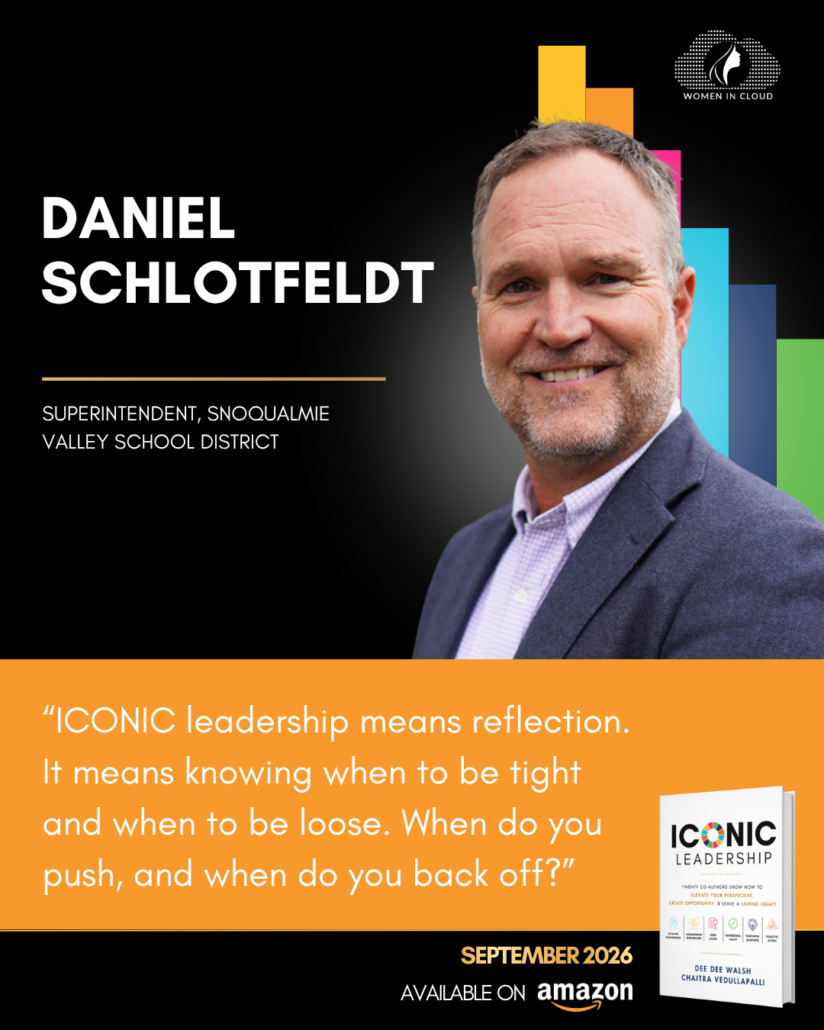
Daniel Schlotfeldt: The Leadership Discipline of Knowing When to Push and When to Listen
Leadership often asks people to hold two responsibilities at once.
A leader must provide direction, yet remain open to perspectives that could change the direction. They must create clear expectations without silencing the people responsible for carrying them forward. They must know when to push for progress and when to step back, listen, and allow trust to develop.
For Daniel Schlotfeldt, this balance is not a contradiction. It is one of the central disciplines of leadership.
His perspective was shaped long before he became a superintendent. Growing up on a farm in Eastern Washington, Daniel learned the value of hard work, problem-solving, and reflection. When equipment broke or a task did not go as planned, the expectation was not perfection. The expectation was to learn, adjust, and finish the work.
That early lesson stayed with him as he moved into education.
As a young teacher and later a principal, Daniel began to recognize that leadership was not about having every answer. It was about creating the conditions in which the collective could contribute to a stronger one. He learned to listen to people with more experience, understand the strengths they brought, and still accept responsibility for the final decision.
Listening, in Daniel’s leadership practice, is not passive.
It means listening to learn rather than simply waiting for an opportunity to speak. It means paying attention with your whole body, removing distractions, taking visible notes, and showing people that their contribution has been received. It also means understanding the difference between reacting with a decision already made and responding after the information has truly been considered.
That distinction matters in complex systems.
As a superintendent, Daniel works across a wide community of students, educators, administrators, families, board members, and operational teams. Each group brings different needs, experiences, responsibilities, and expectations. Consensus cannot be built by pretending those differences do not exist. It must be built by involving people in the agreements that will shape their shared work.
Daniel believes stakeholders must participate in creating community agreements. Otherwise, the agreement is simply a rule imposed on them. At the same time, he recognizes that leadership still requires clarity about what is negotiable and what is not.
This is where his story connects naturally to Collaborative Partnerships and Collective Action within ICONIC Leadership.
Daniel’s leadership is grounded in the belief that the whole becomes stronger when people are genuinely heard, positioned according to their strengths, and given opportunities to lead. His legacy is not only found in the decisions he makes for a school system. It is found in the leaders he develops and leaves behind.
His chapter invites readers to examine the quality of their own listening, the assumptions they carry into decision-making, and the balance they strike between firmness and flexibility.
Because leadership is not only about moving people forward.
It is also about understanding when to slow down, reflect, and make sure the people moving with you have helped shape the path.
Learn More & Get Involved
✍️ ICONIC Leadership Assessment – https://womenincloud.com/iconicleadershipassessment/
▶️ ICONIC Leadership Podcast – https://open.spotify.com/show/6EizaFqN8adxa6WcWPJV0e?si=b442899535694682
📖 ICONIC Leadership Book – https://shop.ingramspark.com/b/084?params=owAAc4hbwh8riSosnpCgvnssQZ0ryWU9ZritStkw3F3