
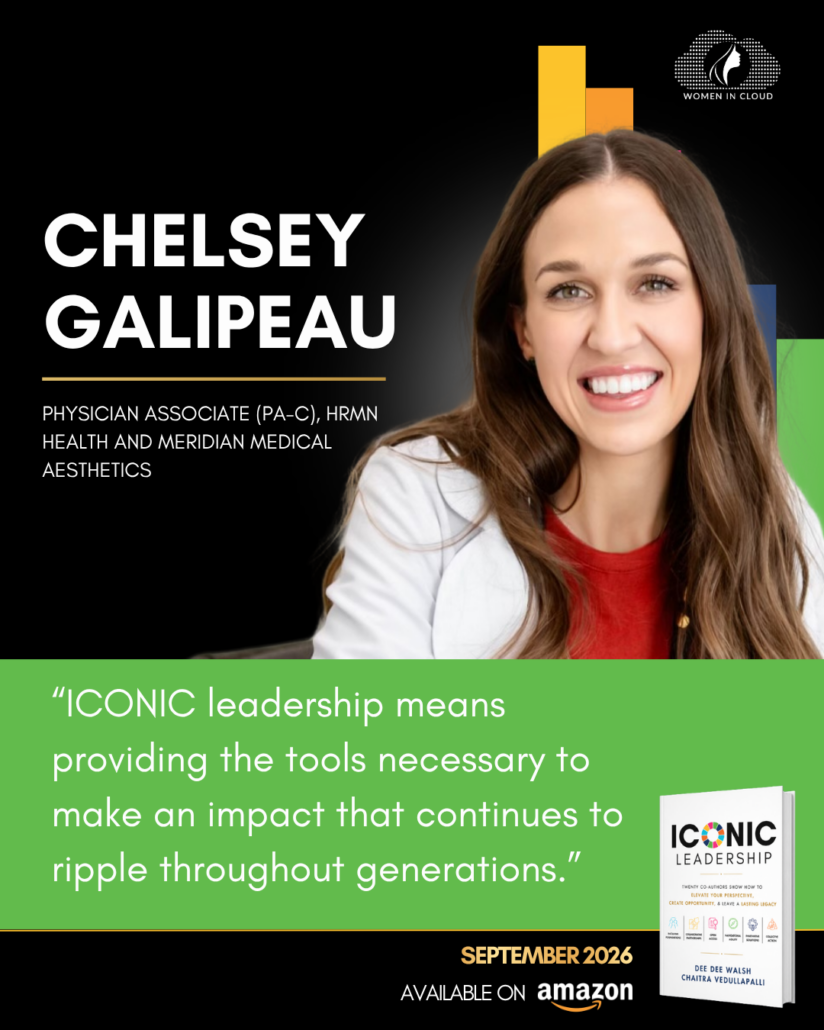
Chelsey Galipeau: When Health Access Becomes Leadership Infrastructure
What happens when a capable, high-performing leader suddenly feels unable to think, communicate, or operate at the level she knows she can?
Too often, the answer is framed as a personal failure. She needs to manage stress better. Become more disciplined. Push through the exhaustion. Adjust to a demanding season.
Chelsey Galipeau offers a different perspective.
Through her work in hormone health, Chelsey has seen how changes in metabolic and hormonal health can affect sleep, cognition, mood, confidence, and executive functioning. These are not isolated wellness concerns. They can shape how a woman participates in meetings, makes decisions, leads a team, pursues advancement, and sustains her long-term ambitions.
Chelsey’s leadership story began with a desire to fill gaps in care. Early exposure to underserved communities showed her that access to healthcare is not distributed equally. Later, while working in endocrinology, she recognized another gap hiding in plain sight. Women were searching for answers, yet the traditional system often gave them too little time, too little education, and too few opportunities to understand what was happening in their own bodies.
For Chelsey, the challenge was not simply clinical. It was structural.
A brief appointment could not always hold the full reality of a woman’s health, responsibilities, stressors, symptoms, and goals. When people are not given time, context, or understandable information, they are limited in their ability to participate in decisions about their own care.
Chelsey chose to build differently.
Her approach centers education, collaboration, and the belief that patients should have a voice in the decisions affecting their lives. Rather than asking people to follow instructions without context, she wants them to understand their options, advocate for themselves, and work in partnership with their providers.
This is where her story connects powerfully to Navigational Agility and Innovative Solutions within ICONIC Leadership. Access is not only about whether a service exists. It is also about whether people can reach it, understand it, trust it, and use it to make informed choices. Innovation begins when leaders question systems that are technically functioning but failing to meet the deeper needs of the people inside them.
Chelsey’s chapter invites readers to reconsider the relationship between health and leadership. It asks what becomes possible when people are given the knowledge and tools to recognize that a change in performance may not reflect a loss of ability, ambition, or potential.
Her deeper framework remains for the book, but its central promise is clear: people deserve more than dismissal. They deserve education, validation, options, and hope.
Because when a person regains ownership of their health, the impact rarely ends with them. It reaches their work, their relationships, their confidence, and the generations watching what they make possible.
Learn More & Get Involved
✍️ ICONIC Leadership Assessment – https://womenincloud.com/iconicleadershipassessment/
▶️ ICONIC Leadership Podcast – https://open.spotify.com/show/6EizaFqN8adxa6WcWPJV0e?si=b442899535694682
📖 ICONIC Leadership Book – https://shop.ingramspark.com/b/084?params=owAAc4hbwh8riSosnpCgvnssQZ0ryWU9ZritStkw3F3