
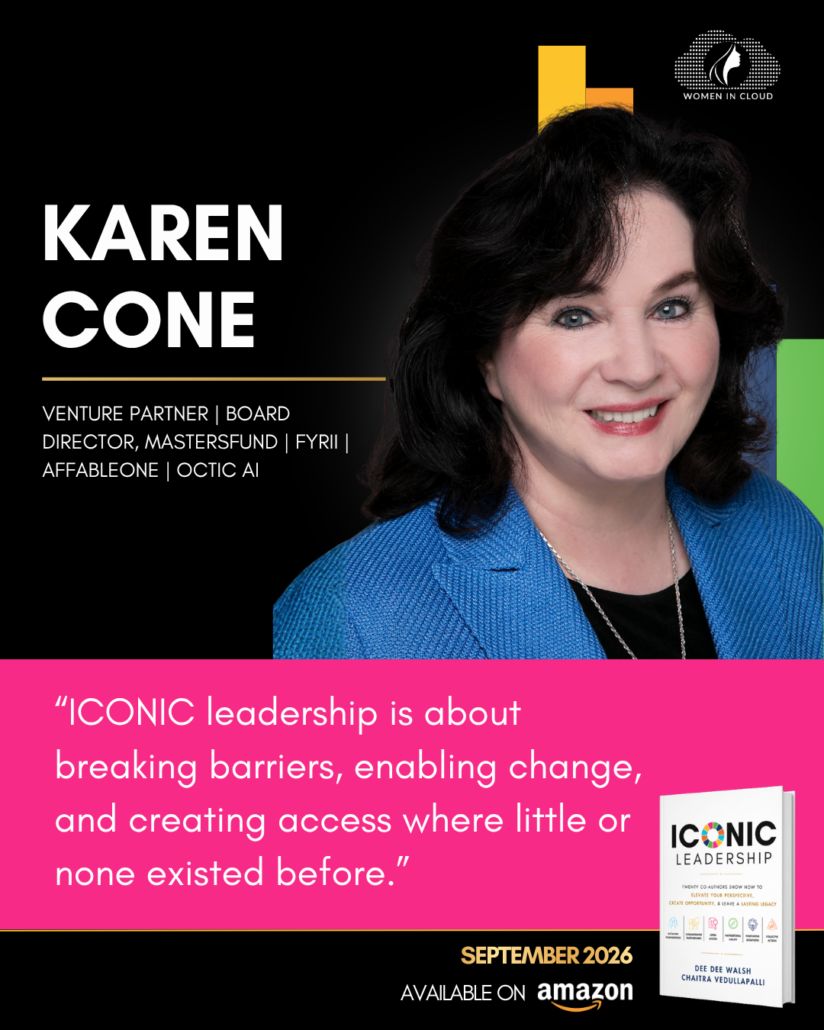
Karen Topping Cone: Creating Access Where Little Existed Before
Breaking a barrier is not always a single dramatic act.
Sometimes it begins with recognizing that a system, opportunity, or path was not designed to include everyone. Sometimes it means entering an unfamiliar space, understanding how influence works within it, and then helping others navigate it more successfully. And sometimes the leader’s most important role is not to make every change personally, but to create the conditions that allow change to become possible.
For Karen Topping Cone, this is where iconic leadership begins.
Her perspective was shaped long before she entered the technology industry, the C-suite, or the boardroom. Growing up across countries, cultures, and political systems exposed her to profound differences in privilege, opportunity, and economic access.
As a child living in Moscow and visiting family in India, Karen saw communities separated not by talent or potential, but by the opportunities and resources available to them. She remembers questioning why some people lived with security and abundance while others struggled for basic necessities. By the age of nine or ten, she was already wondering how people could be given greater economic access and pathways out of poverty.
That early awareness became part of the way she understood leadership.
Throughout her career, Karen repeatedly stepped into industries and roles where she was not the obvious or traditional choice. She entered technology without a conventional technical background, helped organizations navigate periods of transformation, and became known for connecting emerging innovation with the needs of businesses and the people expected to use it.
Her career reflects Navigational Agility, but her philosophy goes further than personal adaptability.
Karen does not define leadership only by a person’s ability to succeed through change. She sees leadership as the ability to enable change for others. That distinction matters.
Leaders do not have to control every outcome or personally execute every transformation. They do need to recognize where progress is being blocked, bring the right people together, and create enough trust, clarity, and access for movement to begin.
Karen learned this lesson in her own advancement as well.
At one point in her career, she was told that although she was producing excellent work, she was being viewed as a worker rather than a leader. Like many women, she had believed that strong results would speak for themselves. She had to learn that visibility, confidence, and the ability to communicate value also influenced who received access to leadership opportunities.
She did not respond by abandoning substance. She learned to make that substance visible.
Karen began entering rooms with greater intention, communicating achievements clearly, and presenting herself as someone prepared to lead. That experience also made her more aware of how easily other people’s contributions could be overlooked.
Once she gained greater influence, she used it to redirect recognition to those whose voices were not being heard. When an idea introduced by a woman was ignored and later repeated by someone else, Karen would bring the conversation back to the original contributor and invite her to expand on it.
That small intervention reflects a much larger leadership choice.
It breaks a barrier to visibility. It enables someone else to participate with authority. It creates access to recognition that might otherwise have been lost.
This is where Karen’s story connects naturally to Open Access and Collaborative Partnerships within ICONIC Leadership.
For Karen, leadership is not about taking ownership of every idea or positioning oneself as the sole source of progress. It is about recognizing the value others bring and using collective strengths to produce something greater. As she explains elsewhere in the interview, leadership must be about “we” and about making “one plus one equal three.”
Her chapter invites readers to reconsider what it really means to create change.
It asks leaders to look beyond their own advancement and examine the barriers surrounding them. Who lacks access to the room? Whose work is being overlooked? Which innovation is ready, but not yet aligned with the people expected to use it? And how can a leader create the conditions for others to move forward?
Because iconic leadership is not only about being the person who crosses the barrier.
It is about weakening that barrier, enabling change, and ensuring that those who follow encounter more access than existed before.
Learn More & Get Involved
✍️ ICONIC Leadership Assessment – https://womenincloud.com/iconicleadershipassessment/
▶️ ICONIC Leadership Podcast – https://open.spotify.com/show/6EizaFqN8adxa6WcWPJV0e?si=b442899535694682
📖 ICONIC Leadership Book – https://shop.ingramspark.com/b/084?params=owAAc4hbwh8riSosnpCgvnssQZ0ryWU9ZritStkw3F3