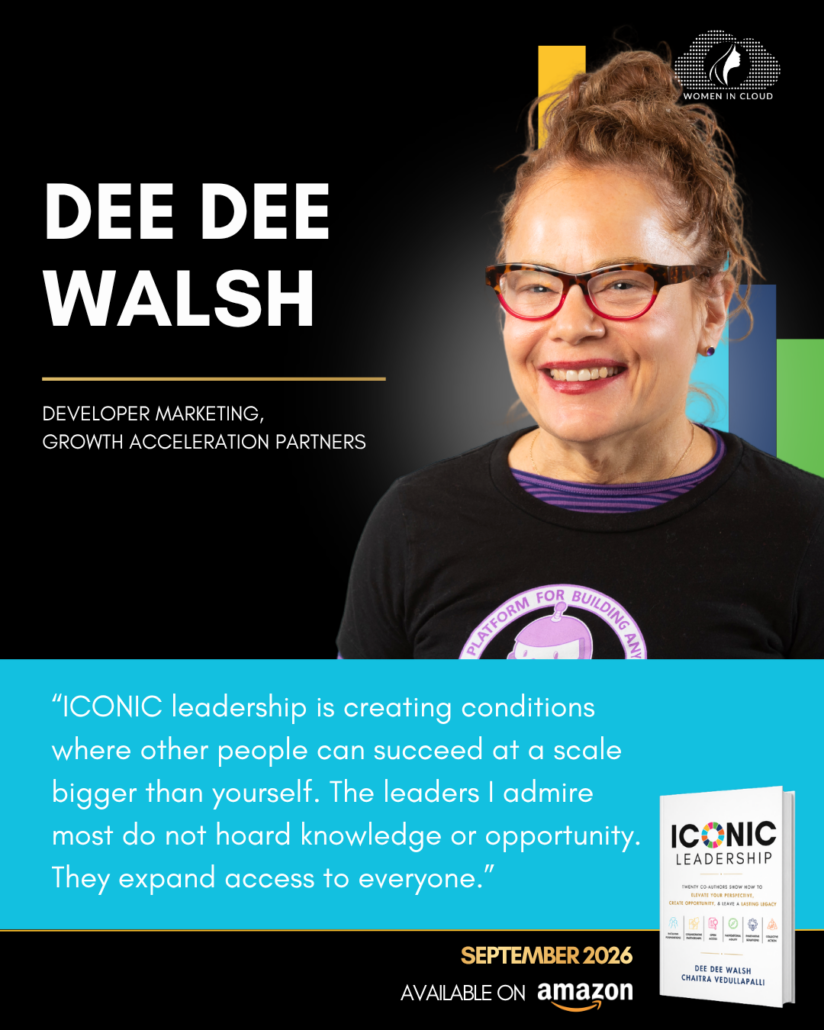
Dee Dee Walsh: Expanding Access in an Age of Intelligent Machines
Every major technology shift creates a choice.
It can concentrate knowledge, influence, and opportunity in the hands of those who already have access. Or it can lower barriers, invite new people into the conversation, and expand what more of society is able to create.
For Dee Dee Walsh, that choice has shaped a career spent at the intersection of technology, people, and possibility.
Her perspective was formed long before artificial intelligence became a defining business conversation. Growing up near Seattle, Dee Dee was surrounded by adults who volunteered their time to help young people explore science and technology. That early service ethic left a lasting impression: knowledge was not something to protect for personal advantage. It was something to share.
That belief continued through her work in software and her 21 years at Microsoft, where Visual Basic revealed what can happen when technology becomes more accessible. Software development had once felt gated by specialized education, technical systems, and permission from established experts. Visual Basic lowered those barriers, allowing business analysts, hobbyists, and people without traditional computer science backgrounds to build applications that solved real problems.
It did more than create developers. It created opportunity.
Today, Dee Dee sees artificial intelligence as another democratization moment. AI is reducing the distance between an idea and its execution. People no longer need the deepest technical expertise to begin creating, testing, or contributing. But access alone is not enough.
As technology becomes faster, leadership must become more discerning.
Dee Dee believes the leadership challenge has shifted from managing information to managing judgment. AI can synthesize research, generate content, write code, and accelerate analysis. What it cannot replace is human responsibility. The closer a decision comes to trust, values, people, or consequences, the more essential human accountability becomes.
Her approach connects deeply to the ICONIC Leadership pillars of Open Access and Inclusive Foundations. Open Access asks leaders to remove barriers to information, tools, networks, technology, and opportunity. Inclusive Foundations reminds us that the people shaping technology must reflect the society affected by it. As Dee Dee observes, when the people building technology do not reflect society, the outcomes will not reflect society either.
This is why her leadership is not centered on controlling every answer. It is centered on creating the conditions in which more people can participate, contribute, and succeed.
Her chapter introduces the idea of the leader as a growth anchor: someone who creates stability while expanding opportunity, and who helps an organization scale without losing its humanity. In moments of transformation, that role matters because technological change rarely affects systems alone. It affects identity, confidence, relationships, and people’s sense of where they belong.
Dee Dee’s story invites readers to reconsider what progress should look like.
It is not enough for technology to become more powerful. It must also become more participatory. It is not enough for organizations to move faster. They must preserve judgment, accountability, and humanity as they move. And it is not enough for leaders to gain access themselves. They must build the infrastructure through which others can enter.
Because the enduring measure of leadership is not how much knowledge a leader holds.
It is how widely opportunity expands because they chose to share it.
Learn More & Get Involved
✍️ ICONIC Leadership Assessment – https://womenincloud.com/iconicleadershipassessment/
▶️ ICONIC Leadership Podcast – https://open.spotify.com/show/6EizaFqN8adxa6WcWPJV0e?si=b442899535694682
📖 ICONIC Leadership Book – https://shop.ingramspark.com/b/084?params=owAAc4hbwh8riSosnpCgvnssQZ0ryWU9ZritStkw3F3