
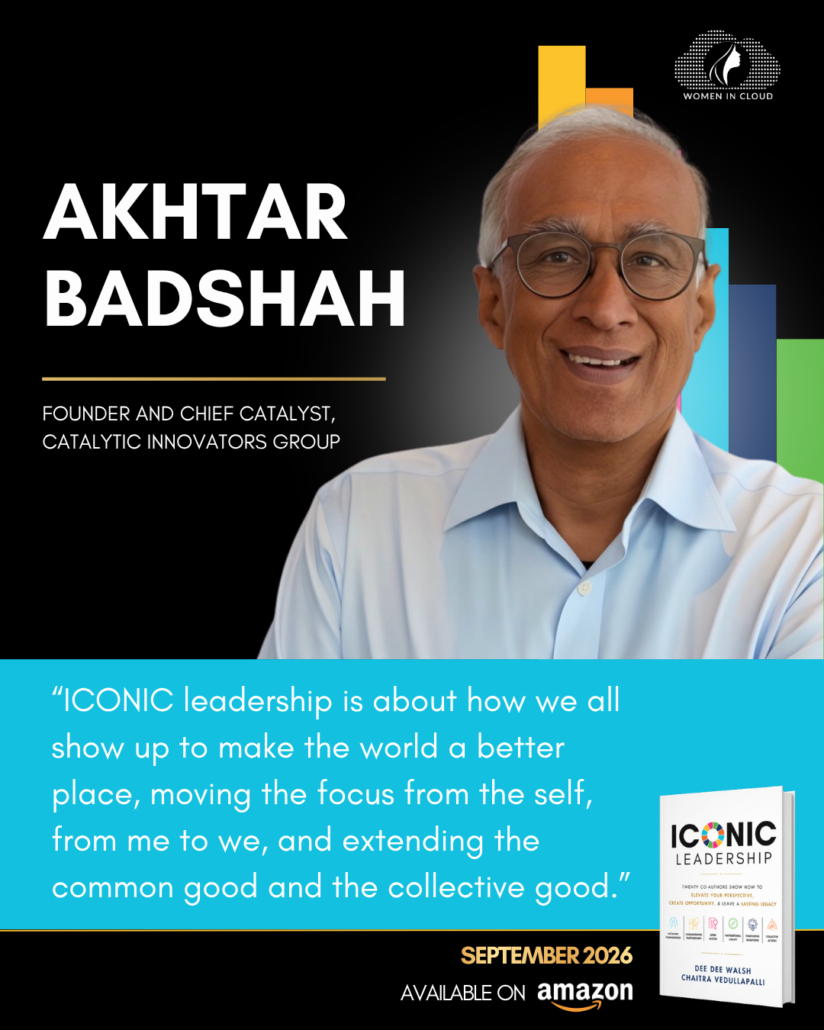
Akhtar Badshah: Leadership Begins with How You Show Up
What if leadership has less to do with being in charge and more to do with how you enter a room, respond to another person, or use the access already within your reach?
For Akhtar Badshah, leadership is not a title to claim. It is a way of showing up.
That distinction has shaped a journey spanning architecture, academia, global development, technology, philanthropy, teaching, and community impact. Across these different environments, Akhtar has moved between people in positions of extraordinary influence and communities too often excluded from opportunity. Yet his attention has consistently returned to the same question: how can we show up in a way that extends the common good?
His answer begins with humility.
Early in his career, representing institutions such as MIT and the Aga Khan Program opened doors around the world. Akhtar understood, however, that institutional access did not make him the expert in every room. Instead of arriving with answers, he arrived ready to listen. He asked communities, practitioners, and local leaders to share what they knew. That approach transformed access from a symbol of status into a bridge for participation.
The same principle later influenced his work in global philanthropy. Rather than assuming that a funder knew what communities needed, Akhtar advocated for listening first. Decisions became more inclusive when local voices helped shape them. Even when funding was not possible, the relationship did not have to end with rejection. A “no” could still include guidance, connection, technology, volunteers, or another pathway forward.
This is where Akhtar’s story connects deeply with Open Access and Collective Action within the ICONIC Leadership ARC.
For him, access is not complete when a door is technically open. It becomes meaningful when people are invited to enter, touch, experiment, contribute, and discover what may be possible for them. Whether he was sharing a camera with a child or placing new technology into the hands of young people who had never encountered it before, the principle remained the same: people need more than distant visibility. They need the opportunity to experience possibility for themselves.
Akhtar also challenges the assumption that meaningful impact must begin on a global stage. Showing up can begin inside a family, a workplace, a faith community, or a neighborhood. The scale may differ, but the responsibility is the same. Each person can make choices that move attention beyond the self and toward a wider collective good.
His chapter invites readers to reconsider the difference between doing more and being more effective. It asks what may change when we stop measuring leadership only through efficiency, hierarchy, and individual accomplishment, and instead examine the quality of our presence, our decisions, and our contribution.
The deeper practices behind that shift are reserved for the full chapter. But Akhtar leaves us with a question that can begin working immediately:
How are you showing up?
Not someday, when the title arrives or the platform becomes larger. Today, in the space you already occupy, with the people already around you.
Because leadership becomes lasting when “me” begins to make room for “we.”
Learn More & Get Involved
✍️ ICONIC Leadership Assessment – https://womenincloud.com/iconicleadershipassessment/
▶️ ICONIC Leadership Podcast – https://open.spotify.com/show/6EizaFqN8adxa6WcWPJV0e?si=b442899535694682
📖 ICONIC Leadership Book – https://shop.ingramspark.com/b/084?params=owAAc4hbwh8riSosnpCgvnssQZ0ryWU9ZritStkw3F3