Lisa Ann Edwards Saved a Coaching Program by Proving Its ROI. Twenty Years Later, She’s Doing the Same Thing for Enterprise AI.

The program was working. The executives just couldn’t see it.


Three months into her first talent management role at an organization where every executive had a coach, and coaching was genuinely embraced, Lisa Ann Edwards watched the budget get cut. Not because the results weren’t real. Because no one had built the financial case to prove they were.


She built it. The coaching program came back. And the question that forced her hand, “What are we actually getting back from this?” never really left her.
That was twenty years ago. Since then, Edwards has collected more than two million data points on leadership performance, coaching effectiveness, and ROI across some of the most demanding organizations in the world. The methodology she developed to answer one CFO’s skepticism became the foundation of a career, and eventually, a company.


Excelia exists because the question hasn’t changed. It has simply gotten more expensive.
“Companies are spending millions on AI and still can’t explain the business impact,” she says. “I built Excelia to connect AI, coaching, workflow improvement, and ROI so organizations can turn AI from expensive experimentation into measurable ROI.”


The platform combines performance coaching with technology to help enterprise organizations identify high-value AI workflows, build practical solutions, measure impact, and surface it all in an executive dashboard that speaks the language CFOs actually need. It is, at its core, an argument that enterprise AI is not purely a technology problem, it is a coaching, performance, and implementation problem with a financial model attached.


Edwards works with Fortune 500 organizations across defense, financial services, pharma, and healthcare. The kinds of institutions where the pressure to show AI’s value is matched only by the difficulty of actually doing it. These are not organizations experimenting casually. They are organizations that have already spent the money and now need someone to show them what they bought.

Lisa Ann Edwards has always had an answer. Now, for the first time, she has a platform powerful enough to prove it at scale.

Learn More & Get Involved
🎬 Watch the ICONS Movie — Meet the women behind the movement. icons by Women in Cloud
📣 Read the Campaign Launch — See how #FoundHerWorld is converting conversations into capital. Women in Cloud Launches #FoundHerWorld
✍️ Nominate a Founder — Know someone who belongs in this spotlight? Submit a Nomination

In a world increasingly driven by data and speed, Jennifer Zarate chose to lead with something more timeless: story.

Jennifer first discovered journalism in high school and spent more than a decade reporting in front of and behind the camera. In newsrooms and field reports, she sharpened her instincts not just as a storyteller, but as a listener. A witness to complexity. A believer in connection.

That belief eventually led her to Microsoft, where she helped reshape how stories of innovation, access, and equity were told. As a Senior Communications Manager, she wasn’t just producing content; she was building platforms. Together with her team, she launched the Microsoft Partner Innovation (MPI) Vodcast, a video podcast that became a global stage to celebrate stories of progress with purpose.

Through it, she amplified bold initiatives: the Black Partner Growth Initiative, Microsoft Build for 2030, and women-led ventures using technology to tackle global challenges. The work expanded access, gave visibility to voices too often left out of the spotlight, and transformed storytelling into a force for inclusion.

On LinkedIn, the MPI Vodcast drew more than 163,000 views, 300,000 impressions, and thousands of engagements. These numbers reflected more than reach—they represented trust, impact, and the collective effort to create thoughtful, engaging content. Jennifer understood that reach means little without resonance. Her work didn’t just perform; it connected.

Her time at Microsoft was a turning point. She evolved from a “one-woman band” to a cross-functional collaborator, learning to scale impact through teams, tools, and strategy. That growth set the stage for what came next.

As Founder and CEO of Growth Mindset Media, Jennifer now partners with mission-driven leaders to craft stories that build credibility and spark influence, while helping them show up with clarity, confidence, and connection. Her mission remains steady: to amplify diverse voices and ensure every community feels seen, heard, and valued.

When every community is reflected in the stories we tell, possibility becomes power, and that is the story I strive to share.” – Jennifer Zarate

And for a generation still waiting to see themselves reflected in the world they help shape, that kind of story might be the most powerful one yet.

About #empowHER50 campaign: This campaign celebrates women leaders at Microsoft, past and present, who have been instrumental in democratizing access to technology, opportunity, and growth. By honoring their contributions over the last half-century, this campaign highlights stories of resilience, innovation, and inclusivity. Through digital spotlights, a commemorative coffee table book, live recognition events, and more, the campaign inspires collective action toward achieving equitable societal goals. To learn more about empowHER50, please visit https://womenincloud.com/empowHER50

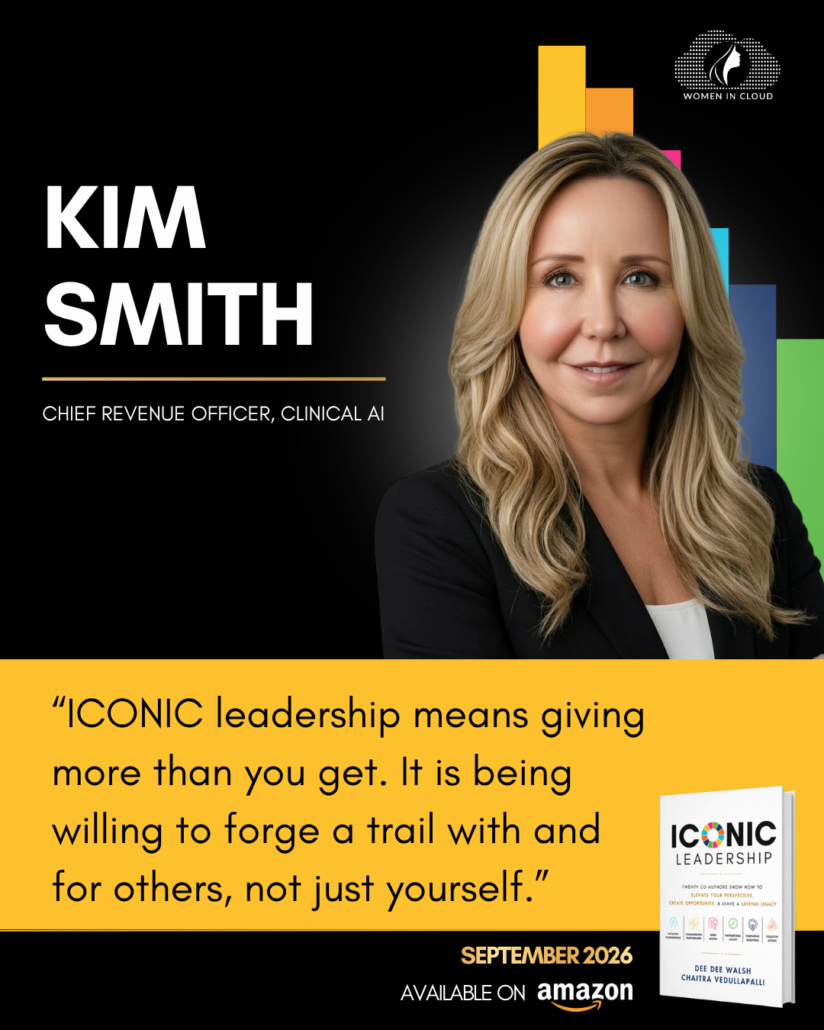
In the early 2000s, long before “cloud-first” became a corporate mantra, Kim Smith stood at the intersection of code and conviction. At a time when software still arrived in shrink-wrapped boxes, she dared to ask: What if work didn’t have to live on a hard drive? What if productivity could travel as fluidly as ideas? 

As the first female leader on Microsoft’s Business Division Strategy team, Smith didn’t just imagine the future; she quietly engineered it. Tucked behind the scenes of what would become Office Online, and later, Office 365, she helped architect the company’s earliest foray into cloud-based productivity, transforming not just how we work, but where

“Suspend disbelief just long enough to let the art of the possible break through and unlock extraordinary outcomes” is a mantra that guided her as she built monetization models and user experience algorithms for the tech giant’s then-experimental online suite. 

But Smith’s story isn’t just about systems. It’s about the scale of both vision and impact. 

Tasked with leading the Customer Experience Improvement Program (CEIP), she brought a human lens to data. Her algorithms parsed anonymized usage patterns across applications like Excel, PowerPoint, and Outlook, revealing something profound: it wasn’t just engineers or executives shaping how tools were adopted, it was often administrators, operations managers, and project leads who were influencing the process and ways to unlock business value. Many were women. Many were overlooked. 

Smith saw an opportunity to reframe the narrative by empowering those most likely to teach and champion adoption.  The result? Office 365 launched in 2011 and grew into the world’s most widely adopted enterprise SaaS suite, with over 400 million paid seats and counting. Microsoft’s identity evolved from a product company to a cloud platform, and Smith helped light that path. 

But for her, the impact was always more than technical. 

Office Online democratized access by offering lightweight, browser-based tools for free. More importantly, it unlocked economic opportunity, especially for users who historically lacked enterprise IT infrastructure. It wasn’t just software in the cloud; it was a ladder. 

Her top strategies were deceptively simple: listen with curiosity, design with empathy, and never underestimate the power of small features that spark joy. She brought this ethos to every decision, bridging data with design, and strategy with soul. 

Today, as Chief Revenue Officer in Clinical AI, Smith continues to infuse analytics with impact, this time with a targeted industry lens: Healthcare and Life Sciences . But her legacy at Microsoft is unmistakable. She didn’t just enable the move from software to the cloud. She helped thousands of people, especially women, move forward with it. And in doing so, she proved that true innovation is not just technical. It’s personal and when personal courage meets collective possibility, the future of innovation becomes limitless. 

About #empowHER50 campaign: This campaign celebrates women leaders at Microsoft, past and present, who have been instrumental in democratizing access to technology, opportunity, and growth. By honoring their contributions over the last half-century, this campaign highlights stories of resilience, innovation, and inclusivity. Through digital spotlights, a commemorative coffee table book, live recognition events, and more, the campaign inspires collective action toward achieving equitable societal goals. To learn more about empowHER50, please visit https://womenincloud.com/empowHER50 

For Vatika Gupta, access to technology isn’t just a feature, it’s a foundational right. With nearly two decades of relentless innovation, she’s made it her mission to transform tech from a privilege into a platform for possibility. 

At Microsoft, Vatika leads global cloud infrastructure efforts, focusing on emerging and underserved markets. Her work streamlining provisioning and deployment strategies has enabled faster, more efficient data center rollouts, bringing affordable, scalable cloud services to communities that need them most. Whether it’s powering educational platforms, telehealth networks, or local small businesses, her engineering vision reaches far beyond code. 

Before Microsoft, at Intel, Vatika helped re-architect cloud insight software into a modular, microservices-based platform, making AI-driven edge computing accessible to industries like manufacturing and logistics, even in environments with limited connectivity. 

At the heart of all of this lies a simple, powerful philosophy: 
“Build what lifts, share what grows—make tech a path that freely flows.” 

It’s a mindset that shapes every decision Vatika makes, whether simplifying complex systems, expanding infrastructure into hard-to-reach regions, or mentoring those just starting their tech journeys. 

Her designs turned once-complex systems into tools that enabled real-time insights across the globe. But for Vatika, the work doesn’t stop at systems, it starts with people. She’s built diverse, high-performing teams from the ground up, mentored rising technologists from nontraditional paths, and championed inclusion not as a checkbox, but as a cornerstone of innovation. 

Her journey, uninterrupted for 19 years, hasn’t always been easy. It’s taken resilience, sacrifice, and bold leadership to carve space in the tech world while balancing personal responsibilities. But through it all, her conviction remains: Technology is only powerful when it’s universally accessible.  

About #empowHER50 campaign: This campaign celebrates women leaders at Microsoft, past and present, who have been instrumental in democratizing access to technology, opportunity, and growth. By honoring their contributions over the last half-century, this campaign highlights stories of resilience, innovation, and inclusivity. Through digital spotlights, a commemorative coffee table book, live recognition events, and more, the campaign inspires collective action toward achieving equitable societal goals. To learn more about empowHER50, please visit https://womenincloud.com/empowHER50 

Nindy Hunter has spent her career turning good intentions into tangible outcomes, especially for communities too often overlooked by traditional tech solutions.

From early work with Microsoft’s Unlimited Potential Group, where she helped design products for developing markets, to leading transformative customer feedback programs today, Nindy’s approach has remained consistent: listen deeply, remove friction, and build with equity in mind. 

Her impact spans product, strategy, and people. Through feedback-driven initiatives in underserved regions, she helped resolve over 75 product and support blockers, improving customer satisfaction by 15 points and influencing more equitable investments. With the Accelerate program, she enabled customers to modernize their tech stack, cutting deployment time by up to 40% and delivering real cost savings. 

Nindy also helped bring sustainability to the forefront of infrastructure planning, translating renewable energy goals into differentiators that resonate with customers. Her work made sustainability not just a checkbox, but a business advantage. 

Beyond technical strategy, Nindy is a passionate mentor and community advocate. As a Leadership Circle sponsor and active member of Employee Resource Groups, she’s mentored over 60 professionals, many of whom have stepped into broader leadership roles. 

Her philosophy is rooted in action: access isn’t just about what’s available, it’s about what’s possible when systems are designed with intention, inclusion, and impact. 

 
About #empowHER50 campaign: This campaign celebrates women leaders at Microsoft, past and present, who have been instrumental in democratizing access to technology, opportunity, and growth. By honoring their contributions over the last half-century, this campaign highlights stories of resilience, innovation, and inclusivity. Through digital spotlights, a commemorative coffee table book, live recognition events, and more, the campaign inspires collective action toward achieving equitable societal goals. To learn more about empowHER50, please visit https://womenincloud.com/empowHER50 

To learn about Microsoft 50th celebrations: https://news.microsoft.com/microsoft-50/