
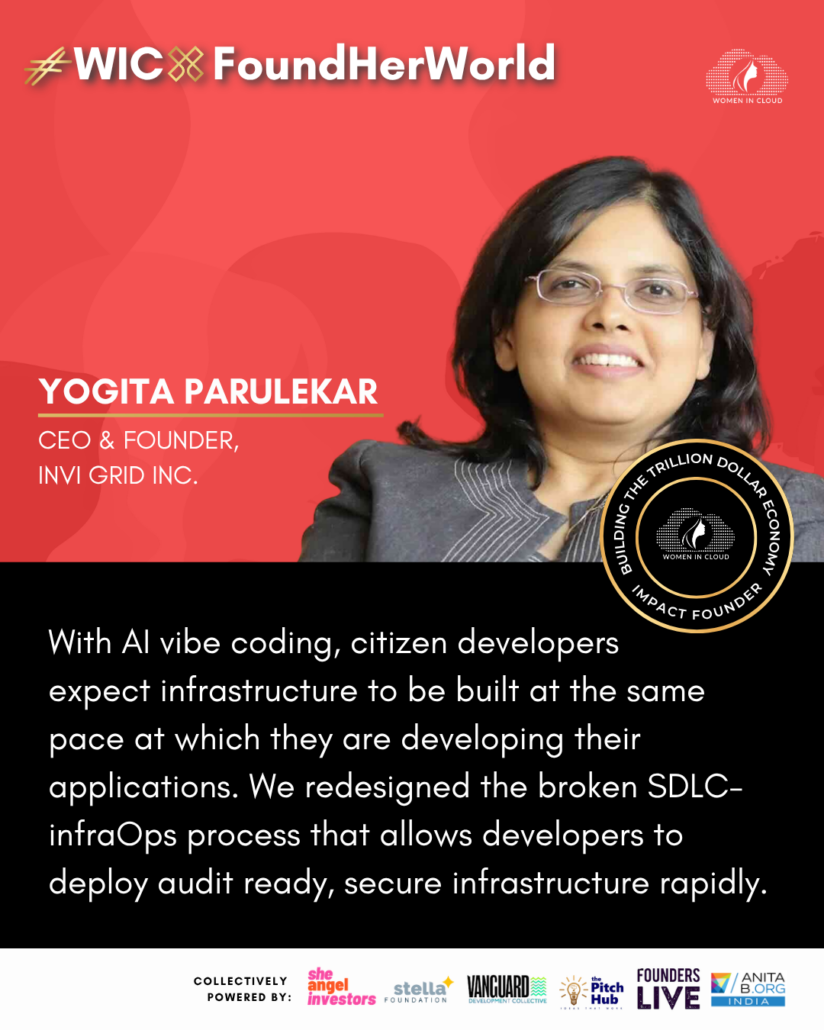
Yogita Parulekar Spent Years Watching Over and Over Again Security Teams Unable to Fix Misconfigured Infrastructure, InviGrid with Secure By Design Infrastructure Is Her Way Out of the Loop

The vulnerability report lands on the security team’s desk. They flag it. They escalate it. And then, almost inevitably, it stays unfixed, because fixing it properly would mean rebuilding the infrastructure which is expensive and time consuming.


This is the quiet dysfunction at the heart of enterprise security: a system designed to find problems it was never empowered to prevent. The underlying architecture and the code needs to be fixed but needs expertise and time. Next quarter, the report looks familiar.


Yogita Parulekar ran security and IT long enough to know this loop by heart. Reactive by design, expensive to escape, and increasingly untenable as the pace of development accelerated around it. The tools were built for a world where infrastructure moved slowly, and developers waited. That world is gone.


AI-driven development, what the industry is beginning to call vibe coding and now vibe engineering, has changed the equation entirely. Citizen developers are building and deploying at speeds that leave traditional infrastructure and compliance processes gasping to keep up. Security, already reactive, is falling further behind.


“With AI vibe coding, citizen developers expect infrastructure to be built at the same pace at which they are developing their applications,” Parulekar says. “We redesigned the broken SDLC-infraOps process that allows developers to deploy audit-ready, secure infrastructure rapidly.”


Invi Grid is her answer to the acceleration problem, a platform that makes secure, compliant cloud infrastructure the default rather than the afterthought. Targeting CIOs, CTOs, and CISOs at regulated enterprises with significant cloud investment, the company is defining an entirely new category: Secure Agentic Infrastructure. Patents approved. Customers validating. Partners aligned.
The security industry has spent decades learning to move fast after a breach. Yogita Parulekar is building the infrastructure that makes the breach less likely to begin with.

Learn More & Get Involved
🎬 Watch the ICONS Movie — Meet the women behind the movement. Icons by Women in Cloud
📣 Read the Campaign Launch — See how #FoundHerWorld is converting conversations into capital. Women in Cloud Launches #FoundHerWorld
✍️ Nominate a Founder — Know someone who belongs in this spotlight? Submit a Nomination

Millions of Gig Workers Are One Bad Month Away From Losing Everything. Chukwufumnanya Michelle Isichei Is Building the Net.

The moment you leave a traditional job, something disappears so quietly you almost don’t notice it until you need it.
Health coverage. Income protection. The quiet assurance that if something goes wrong, there is a system designed to catch you. For decades, these protections were built into formal employment, so automatic that most workers never had to think about them. Then the gig economy arrived, and millions of people stepped into a new way of working without any of those protections following them.


Chukwufumnanya Michelle Isichei experienced that shift herself. After years in traditional banking, where insurance and financial protection were simply part of the package, she transitioned into the remote and gig economy space. Suddenly, something as basic as protection became her responsibility to figure out.
She did. But what struck her wasn’t just the inconvenience; it was the scale of the problem.


Millions of freelancers, remote workers, delivery riders, and platform workers across emerging markets were building livelihoods entirely outside the safety systems traditional employment once guaranteed. One unexpected illness, one lost contract, one bad month, and everything they had built could begin to unravel.


What began as a personal realization quickly became a much larger question: how do you build financial protection for an entire generation of workers operating outside traditional systems?
“Insurance was automatic in traditional jobs, but in the gig economy, you’re on your own,” she says. “I’m building GigSecure to change that, creating simple, flexible protection designed for how gig workers actually live and earn.”


GigSecure is an insurance platform built around the realities of irregular income. Its AI-powered risk assessment helps tailor coverage to how gig workers actually earn and live, rather than relying on traditional insurance models that often exclude them. A marketplace for tailored insurance premiums is rolling out in the coming weeks, connecting gig workers with insurers and fintech partners willing to meet them where they are.


The MVP is live. Demand is growing. And millions of gig workers have waited far too long for financial protection designed with them in mind.

Learn More & Get Involved
🎬 Watch the ICONS Movie — Meet the women behind the movement. Icons by Women in Cloud
📣 Read the Campaign Launch — See how #FoundHerWorld is converting conversations into capital. Women in Cloud Launches #FoundHerWorld
✍️ Nominate a Founder — Know someone who belongs in this spotlight? Submit a Nomination
Lisa Ann Edwards Saved a Coaching Program by Proving Its ROI. Twenty Years Later, She’s Doing the Same Thing for Enterprise AI.

The program was working. The executives just couldn’t see it.


Three months into her first talent management role at an organization where every executive had a coach, and coaching was genuinely embraced, Lisa Ann Edwards watched the budget get cut. Not because the results weren’t real. Because no one had built the financial case to prove they were.


She built it. The coaching program came back. And the question that forced her hand, “What are we actually getting back from this?” never really left her.
That was twenty years ago. Since then, Edwards has collected more than two million data points on leadership performance, coaching effectiveness, and ROI across some of the most demanding organizations in the world. The methodology she developed to answer one CFO’s skepticism became the foundation of a career, and eventually, a company.


Excelia exists because the question hasn’t changed. It has simply gotten more expensive.
“Companies are spending millions on AI and still can’t explain the business impact,” she says. “I built Excelia to connect AI, coaching, workflow improvement, and ROI so organizations can turn AI from expensive experimentation into measurable ROI.”


The platform combines performance coaching with technology to help enterprise organizations identify high-value AI workflows, build practical solutions, measure impact, and surface it all in an executive dashboard that speaks the language CFOs actually need. It is, at its core, an argument that enterprise AI is not purely a technology problem, it is a coaching, performance, and implementation problem with a financial model attached.


Edwards works with Fortune 500 organizations across defense, financial services, pharma, and healthcare. The kinds of institutions where the pressure to show AI’s value is matched only by the difficulty of actually doing it. These are not organizations experimenting casually. They are organizations that have already spent the money and now need someone to show them what they bought.

Lisa Ann Edwards has always had an answer. Now, for the first time, she has a platform powerful enough to prove it at scale.

Learn More & Get Involved
🎬 Watch the ICONS Movie — Meet the women behind the movement. icons by Women in Cloud
📣 Read the Campaign Launch — See how #FoundHerWorld is converting conversations into capital. Women in Cloud Launches #FoundHerWorld
✍️ Nominate a Founder — Know someone who belongs in this spotlight? Submit a Nomination